|
 |
Endurance Mindset · 🇺🇸 |
Home•Blog•News•Run With Us•Apply•Plans•Store
|
🌍 ¿Recibes esto en el idioma equivocado? Actualiza tus preferencias en el pie → Español 🇪🇸 |
 |
|
👋🏻 Hey Reader!
Saturday September 12 · Week close
We're closing the week with the difference between running and training.
And the difference fits in one word: date.
|
|
The real problem
"I want to run a marathon"
doesn't tell your body what to do
on Tuesday morning.
|
|
|
|
📅 It isn't a discipline problem
Every season I get the same message: "I want to run a marathon", "I want to break 25 minutes in the 5K". The intention is crystal clear. What's almost never clear is the route.
And that's where most new runners get lost. Not from lack of desire — but because nobody taught them to break a big goal into steps they can actually execute week by week. They try to reach the final goal with no intermediate map, get frustrated in week three, and conclude running isn't for them.
|
|
🎯 The three horizons
When someone comes to me with a goal, the first thing we do is break it into three. It isn't just organisation — it's applied psychology: big goals generate anxiety because they're abstract; small ones generate action because they're concrete.
|
SHORT TERM · WEEKS 1-4 |
|
Build the habit, not the performance
Here the goal is not running faster or further. It's simply showing up: three sessions a week regardless of pace, completing each one even if it comes out shorter than planned, and sleeping consistently to see how the body responds.
Almost entirely easy aerobic. Forcing intensity here is the number one cause of dropout and injury in new runners.
|
MEDIUM TERM · MONTHS 2-3 |
|
Base and structure
Variety comes in: some pace work, gentle progressions, and volume rising never more than 10% per week. Measurable but still modest goals — increasing continuous distance, one weekly quality session, and starting to log resting heart rate and perceived effort.
This is where I usually add cross-training — bike or elliptical. For joints that don't yet tolerate high impact, it isn't a compromise: it's a tool.
|
LONG TERM · MONTH 4 ONWARDS |
|
Specificity toward the goal
Only now — with the base built and the body adapted — do we train specifically for the target distance and pace. Threshold work, race paces, and practising event-specific nutrition and hydration.
|
|
|
Why the "30-day plan" doesn't work · PMID:1406202
How efficiently your body uses fat and carbohydrate as fuel changes with consistent aerobic training. That metabolic shift doesn't happen in two weeks — it happens over months, with repeated, progressive exposure.
That's why the plan promising to transform you in a month doesn't match how human physiology works. It isn't that it's demanding. It's that it runs against the body's clock.
|
|
|
🔻 From abstract to weekly
Every big goal has to come down four steps until it becomes something you do tomorrow:
|
| SEASON |
Finish the October marathon |
| BLOCK |
Over the next 6 weeks, raise the long run from 8 to 14 km |
| WEEK |
3 easy runs + 1 long run of 12 km |
| SESSION |
Today: 30 minutes at conversational effort |
This breakdown is what makes a plan sustainable instead of aspirational.
|
|
The ingredient almost everyone ignores · PMID:40667749
The common error is treating rest as "what happens when I'm not training", rather than as an active phase of periodisation.
Both younger and older athletes experience structural and functional cardiac changes with sustained training — and it's gradual progression, not a volume shock, that allows safe, lasting adaptations.
If you're starting after 40 or 50: the heart adapts, but it needs the same respect for progression we give muscles and tendons.
|
|
|
What nobody puts in the goal, but everyone feels
When we talk about goals, we almost always think times, distances, medals. But regular aerobic exercise is associated with increases in BDNF, a protein linked to brain plasticity and mood [PMID:25455510].
When I ask my athletes why they keep running after hitting their original goal, not one mentions their race time. They mention how they feel mentally.
Worth remembering when motivation for the number wavers: the process itself is already delivering.
|
|
|
✅ How to apply this weekend
You don't need a perfect plan. You need a plan with a clear horizon:
|
| › |
Define your season goal with a real date, not an approximate one |
| › |
Count the weeks available and divide them into 3-4 blocks, each with one objective |
| › |
This week, commit only to the short-term phase: consistency, not performance |
| › |
Log something simple — resting heart rate or perceived effort — so you have data, not just feelings |
| › |
Schedule rest as seriously as you schedule training |
The big goal gives you direction.
The blocks give you structure.
The weeks give you action.
None of the three works without the other two.
|
|
|
Your weekend task
Find a race with a real date and write it down.
You don't need to register today. Just the date. Reply with the one you picked and I'll tell you how many blocks I'd split it into.
|
|
Have a good weekend. Back on Tuesday — with the Budapest results. |
|
🎁 Run together, earn rewards
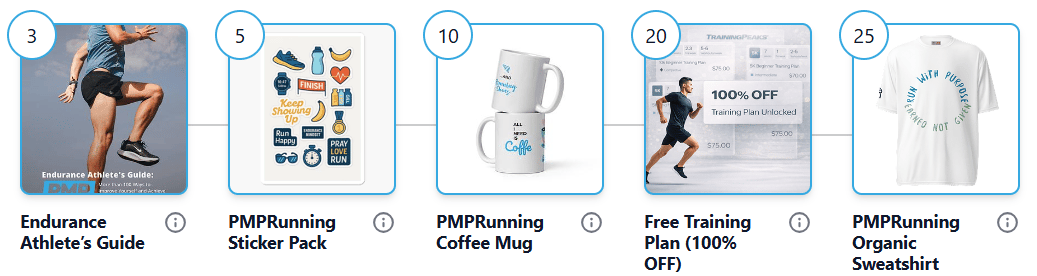
Know someone this email would help? Forward it to them. Every subscriber who arrives through your link brings you closer to the next reward.
|
 |
|
Your personal link to share
[RH_REFLINK GOES HERE]
VIEW MY REWARDS →You have [RH_TOTREF GOES HERE] referrals · Code: [RH_CODE GOES HERE]
|
|
|
|
Coach Henri
USATF · TrainingPeaks · Certified Functional Strength Coach
|
|
|
Pray 🙏 · Love ❤️ · Run 🏃♂️
USA · COL · VEN
Unsubscribe · Update preferences · Actualizar preferencias
© 2026 Project Management of Running LLC · El Paso, TX 79911
|
|
