|
 |
Thu Aug 20 · 🇺🇸 |
Home•Blog•News•Share•Apply•Plans•Store
|
 |
🌍 Receiving this in the wrong language? Update preferences in the footer → Español 🇪🇸 |
|
👋🏻 Hey Reader!
Thursday August 20 · Short edition
We've reached the end of the alphabet. Four parts, twenty-six letters — and today we close with the last eight.
It's no coincidence that the final letters include the concepts that generate the most questions from my athletes: sleep, tapering, threshold, VO2max. They get used a lot and understood very little — and that gap is exactly where I see the most expensive mistakes in race preparation.
|
|
The full series
A–F · G–L · M–R · S–Z
Part 4 of 4 — the final instalment.
|
|
|
|
🔤 From S to Z
| S — SLEEP · The most underrated variable |
| Five bad nights in a row can wipe out the stimulus of an entire well-planned training week. That's where muscle repair, adaptation consolidation and hormonal regulation happen. If you're choosing between an extra 5am session or one more hour of sleep, sleep almost always wins.
|
| T — TAPERING · Drop volume, not intensity |
| You can cut volume by 40-60% while keeping intensity, and not only do you not lose fitness — you arrive fresher and perform better. For a marathon, start 2-3 weeks out; for a 5K or 10K, one week is usually enough. Keep some short reps at race pace so the legs don't fall asleep.
|
| U — LACTATE THRESHOLD · Running fast for a long time |
| Unlike VO2max, threshold responds very well to training even in experienced athletes. It's what separates someone who can run fast from someone who can run fast for a long time. Typical session: 20-40 minutes "comfortably uncomfortable" — a short sentence yes, a conversation no.
|
| V — VO2MAX · Genetic ceiling, but trainable |
| The most studied variable in sports history. It has a significant genetic ceiling, but improves meaningfully with the right work. Intervals of 3-5 minutes near VO2max, with similar recovery. One session every 7-10 days during a specific block is enough.
|
| W — WARM-UP · Not a formality, it's training |
| It raises muscle temperature, improves nerve conduction and prepares the cardiovascular system. For easy runs, 5-10 minutes gentle. For quality sessions: easy jog + dynamic mobility + short strides. Going straight into a fast rep is one of the most common — and most avoidable — ways to get injured.
|
| X — eXCESS TRAINING · When pushing through is the mistake |
| It happens when training stress consistently exceeds your recovery capacity. The classic signs: persistently elevated resting heart rate, insomnia, irritability, stagnation despite training more. If you see two or three together for more than a week, it's time to cut load — not push through.
|
| Y — YOU · The athlete you are today |
| One of the mistakes I see most: training according to the athlete you were five years ago, or the one you think you "should" be. I compete in the 3000 m in the 45-49 masters category, and I adjust my volume and recovery very differently than I did at 25. Ignoring that doesn't make you more disciplined — it makes you more likely to get injured.
|
| Z — STRIDE · Don't force it longer |
| There's no universal perfect stride — there's an efficient one for each pace and each body. Artificially lengthening it increases ground contact time and injury risk: the foot lands well ahead of your centre of mass and brakes on every step. Work on cadence and let the stride lengthen on its own as you build strength.
|
|
|
The science behind this instalment
Running trains the brain. It releases cathepsin B, a protein associated with improvements in memory and cognitive function [PMID:27345423]. And the brain needs sleep to consolidate all of that.
The masters heart responds differently. There's evidence that the hearts of older endurance athletes adapt differently to prolonged exercise than those of younger athletes [PMID:40667749]. Not worse, not better — different. And training should reflect that.
|
|
|
Closing the alphabet
Twenty-six letters and one underlying message: running properly understood isn't a collection of tricks, it's a system where every piece — from how you sleep to how you land — affects the others.
You don't need to master all twenty-six concepts to run well. You need to understand the three or four that are limiting your progress right now, and work on them patiently. The skill of good training — and of a good coach — is identifying which ones, at the moment when they matter.
|
|
|
|
Your question today
Of these eight letters, which one is limiting you the most right now?
Reply with the letter. I'll tell you where to start.
|
|
|
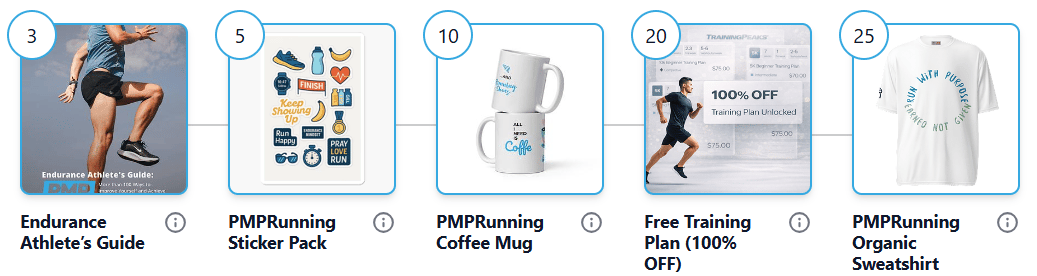
🎁 Run together, earn rewards
Every person who subscribes with your link brings you closer to the next reward. You share, they join, you stack up.
|
 |
|
Your personal link to share
[RH_REFLINK GOES HERE]
VIEW MY REWARDS →You have [RH_TOTREF GOES HERE] referrals · Code: [RH_CODE GOES HERE]
|
|
|
|
Coach Henri
USATF · TrainingPeaks · Certified Functional Strength Coach
Thank you for following the whole series. See you on the track, the road or the trail.
|
|
|
Pray 🙏 · Love ❤️ · Run 🏃♂️
USA · COL · VEN
Unsubscribe · Update preferences · Actualizar preferencias
© 2026 Project Management of Running LLC · El Paso, TX 79911
|
|
