|
 |
Thu Sep 3 · 🇺🇸 |
Home•Blog•News•Run With Us•Apply•Plans•Store
|
 |
🌍 Receiving this in the wrong language? Update preferences in the footer → Español 🇪🇸 |
|
👋🏻 Hey Reader!
Thursday September 3 · Short edition
Not everyone is running Chicago. If your goal is a half, today I'm helping with the decision most people skip: which plan to follow.
Because the best plan in the world, badly chosen, delivers less than a modest one that actually fits you.
|
|
The first thing I ask
It isn't your goal time.
It's what your week looks like.
How many days you can run without stealing hours from sleep. How often you've gone past 16 km in three months. What happened last time you raised volume fast.
|
|
|
|
📋 Why the half is deceptive
It's short enough to tempt you into training it like extended speed work, and long enough to punish any volume dosing error hard. The plans circulating online don't fail because they're badly designed on paper — they fail because they get chosen by goal time rather than by the real capacity of the body that has to execute them.
| Volume predicts performance — and injury · PMID:32421886 |
| In over 1,600 recreational runners, total volume and longest long-run distance related directly to race performance. But injury risk also rose with volume, especially when the increase was abrupt relative to prior base. Choosing a plan isn't choosing how much volume you want — it's how much you can sustain without breaking. |
| Two bodies, same plan, different outcomes · PMID:41922043 |
| Individual response to training — inflammation, muscle recovery, cardiovascular adaptation — varies significantly between athletes with similar profiles. A rigid plan with no room to reduce load when sleep deteriorated or work got heavy is optimised for an athlete who doesn't exist.
|
| The plan that worked at 30 isn't the one for now · PMID:40667749 |
| The heart adapts differently depending on age and years of exposure to endurance training. Your capacity to absorb load changes. Choosing a plan "because it worked before" ignores that physiological evolution.
|
| Many classic plans weren't written for you · PMID:36326961 |
| The half marathon runner's profile changed over two decades: more recreational participation, more age diversity. But many circulating plans were designed for a competitive club runner, not for who actually stands on the start line today. That mismatch is one of the most common causes of mid-season frustration. |
|
|
✅ The five questions
Open the plan you have right now — the one you downloaded, bought, or got from the app. Put it through these five:
|
| 1 |
Does it respect my current base volume?
Week 1 shouldn't ask for more than 10-15% above your average of the last 4 weeks.
|
| 2 |
Is the long-run progression gradual?
Moderate increments with a deload every 3-4 weeks, not a straight ascending line.
|
| 3 |
Does it flex to my recovery?
If it's a fixed table with no margin, you'll end up forcing it or abandoning it when real life interferes.
|
| 4 |
Does it include race pace under fatigue?
Volume and raw speed aren't enough. You need to hold goal pace tired, not run it fresh.
|
| 5 |
Is it calibrated for my age and history?
Or for a generic 28-year-old with a club base?
|
If it answers all five well, it's a good candidate — it doesn't matter whether you downloaded it free, bought it, or a coach built it. |
|
|
The pacing finding almost nobody uses
There are consistent differences in how effort gets distributed in halves and marathons: men tend toward more aggressive starts with sharper drop-offs in the second half, while women show, on average, a more even distribution [PMID:30646638].
The direct application: if your plan doesn't include race-pace rehearsals in the final 30-40 minutes of the long run, you're leaving out one of the skills that most determines the result. It isn't just having the aerobic base — it's knowing how to execute it without falling apart in the last 5 km.
|
|
|
My perspective from the track
Competing in masters 3000 m, I understand the temptation to copy the plan of someone who ran fast, assuming that volume or that interval structure is the formula.
But a coach's job is translating general evidence into each person's specific physiology: their age, their injury history, their real recovery capacity that particular week.
The right plan isn't the one with the most attractive name, or the one your friend who broke 1:35 used. It's the one your body, with its history and its present, can absorb and turn into real adaptation.
|
|
|
|
Your question today
Run your current plan through the five questions. How many does it pass?
Reply with the number and which one fails. I'll tell you whether it's worth adjusting or replacing.
|
|
|
🎁 Run together, earn rewards
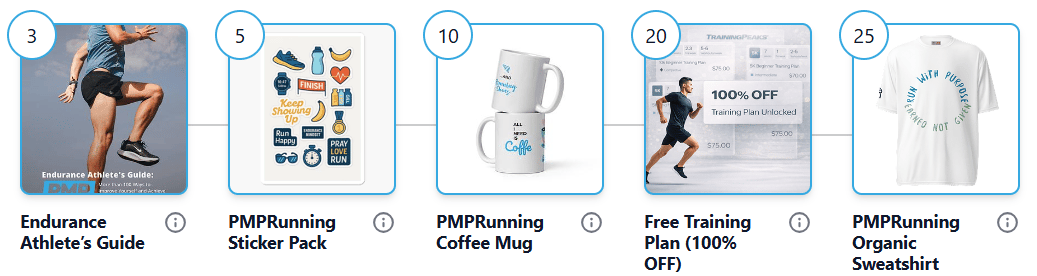
Know someone who copied a faster friend's plan? These five questions will help them. Every subscriber through your link brings you closer to the next reward.
|
 |
|
Your personal link to share
[RH_REFLINK GOES HERE]
VIEW MY REWARDS →You have [RH_TOTREF GOES HERE] referrals · Code: [RH_CODE GOES HERE]
|
|
|
|
Coach Henri
USATF · TrainingPeaks · Certified Functional Strength Coach
Tomorrow: the five markers before running your first marathon.
|
|
|
Pray 🙏 · Love ❤️ · Run 🏃♂️
USA · COL · VEN
Unsubscribe · Update preferences · Actualizar preferencias
© 2026 Project Management of Running LLC · El Paso, TX 79911
|
|
