|
 |
🏙️ Chicago · D-39 · 🇺🇸 |
Home•Blog•News•Run With Us•Apply•Plans•Store
|
|
 |
🌍 Receiving this in the wrong language? Update preferences in the footer → Español 🇪🇸 |
|
👋🏻 Hey Reader!
Wednesday September 2 · Chicago series · 2 of 7
Yesterday we talked about discipline over motivation. Today discipline becomes a number.
A plan without a defined goal pace isn't a plan — it's an intention in running shoes. Let's calculate yours from your current fitness, not from what you'd like to run.
|
|
Sunday October 11 · 7:20 am
39 DAYS
|
|
|
|
🎯 The mistake that costs you a whole marathon
Every September I get the same message: "Henri, my marathon PR is 3:45 — is that my Chicago target?" And every time I have to ask the same uncomfortable question: when did you run that 3:45?
The answer is almost always "a year ago", or "before the injury", or "before the baby". That number was real. But it describes a different version of that runner — not the person who'll be standing in Grant Park on October 11.
|
|
THE NOSTALGIC OPTIMIST
Uses the old PR, goes out aggressively, and blows up at km 30 because current fitness won't hold that pace.
|
|
|
THE INJURY PESSIMIST
Recovered and trained well, but still anchored to fear and runs too conservatively, leaving minutes on the table.
|
|
Opposite error, same cause: using old data instead of recent data.
|
|
📊 My hierarchy of confidence
The volume accumulated in the last 8-12 weeks — not the last 12 months — is what determines your race-day aerobic capacity. Mitochondrial remodelling and capillary density respond to recent stimulus [PMID:41922043].
|
| 1 |
Half marathon from the last 6-8 weeks — the best reference available. |
| 2 |
Recent 10K + current volume (weekly mileage, longest long run, time at threshold). |
| 3 |
Recent 5K — useful, but needs a conservative adjustment if your endurance base is thin. |
| 4 |
Threshold pace from training — very useful as a cross-check. |
Never use just one number.
Cross at least two sources before committing to a pace. |
|
|
📋 Equivalence table
Riegel's formula with a marathon-specific fatigue adjustment — the final 12-15 km impose a metabolic cost that pure extrapolation doesn't capture.
|
| 10K |
HALF |
M PACE |
FINISH |
| 40:00 |
1:28:00 |
4:10 |
2:56 |
| 43:00 |
1:35:00 |
4:29 |
3:09 |
| 46:00 |
1:42:00 |
4:48 |
3:22 |
| 50:00 |
1:50:00 |
5:10 |
3:38 |
| 55:00 |
2:01:00 |
5:40 |
3:59 |
| 1:00:00 |
2:12:00 |
6:11 |
4:20 |
| 1:07:00 |
2:28:00 |
6:53 |
4:50 |
Pace in min/km · Finish time in h:mm. These are starting points, not verdicts. Adjust for your marathon experience, your known heat tolerance, and whether your reference race was a genuine maximal effort or you ran with margin.
|
📡 The Chicago detail almost nobody mentions |
|
The urban canyon will lie to you about your pace
The course runs through the Loop and downtown stretches with skyscrapers, where the satellite signal bounces between buildings. Your watch will show absurd instant paces — sometimes wildly fast, sometimes wildly slow — while your actual effort stays constant.
It sounds like a minor detail until you watch someone surge because their watch flashed a false "slow" pace, burning glycogen they'd need at km 35.
|
✓ Set your watch to show lap average pace, not instant pace.
✓ In skyscraper sections, go by perceived effort.
✓ Use the physical course markers as a reality check.
✓ Never adjust pace off a single reading. Wait 300-400 m to confirm the trend.
|
|
|
🧮 PMPRunCal · Free |
|
To avoid doing these calculations by hand — and above all to avoid the bias of picking the number we like most instead of the one the data suggests — I built a calculator I use in planning sessions with my athletes.
→ Marathon goal pace adjusted for specific fatigue
→ Pace ranges by course block (first 10K, middle section, final 10K)
→ Tempo, threshold and interval paces derived from the same base number, so your whole plan is calibrated off one figure
DOWNLOAD PMPRUNCAL →Still in development, but already well along. Tell me what's missing.
|
|
|
Your tasks these weeks
① Get a real reference mark in the next 2-3 weeks if you don't have one. A 10K or half at genuine effort — not a training run disguised as a race.
② Discard any mark older than 10-12 weeks as the basis for your target. It's historical context, not a calculation input.
③ Practise running by effort in your long runs, especially simulating "blind" stretches without checking GPS.
④ Split your plan into course blocks, not one single pace: the first 10K asks for restraint, the middle asks for patience, and the last 10K decides the result.
|
|
|
On physiological margin
The marathon imposes a measurable cardiovascular load, especially past 40. Both younger and older athletes show acute changes in cardiac function after long efforts, and those markers take time to recover [PMID:40667749].
That's why your goal pace shouldn't be the theoretical maximum your physiology could hold on a perfect day, but one with reasonable margin.
As a masters runner competing in the 3000 m, this isn't theory for me: the space between "ambitious pace" and "reckless pace" narrows with age. Respecting it is what lets you keep competing year after year.
|
|
|
|
Your question today
What's your most recent reference mark — and when was it?
Reply with the distance, the time and the date. I'll tell you whether it works as a base or you need a fresh one.
|
|
|
🎁 Run together, earn rewards
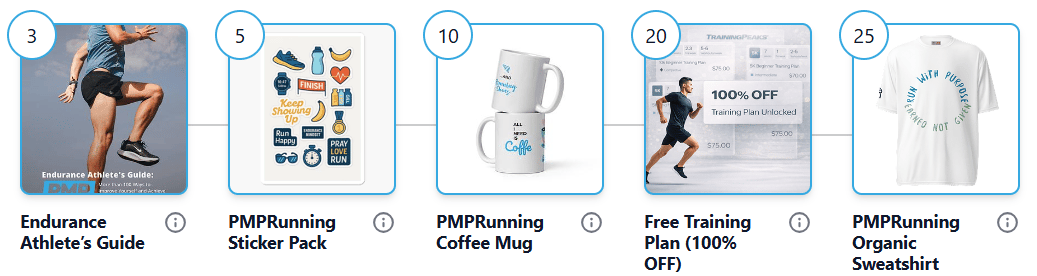
Know someone about to race with a two-year-old PR in their head? Forward this to them. Every subscriber through your link brings you closer to the next reward.
|
 |
|
Your personal link to share
[RH_REFLINK GOES HERE]
VIEW MY REWARDS →You have [RH_TOTREF GOES HERE] referrals · Code: [RH_CODE GOES HERE]
|
|
|
|
Coach Henri
USATF · TrainingPeaks · Certified Functional Strength Coach
Next Wednesday, Chicago 3 of 7: the long run at marathon pace.
|
|
|
Pray 🙏 · Love ❤️ · Run 🏃♂️
USA · COL · VEN
Unsubscribe · Update preferences · Actualizar preferencias
© 2026 Project Management of Running LLC · El Paso, TX 79911
|
|
